my site
The Paradox of “Spite-Shaming”: How toxic artists drive paying clients straight to AI.
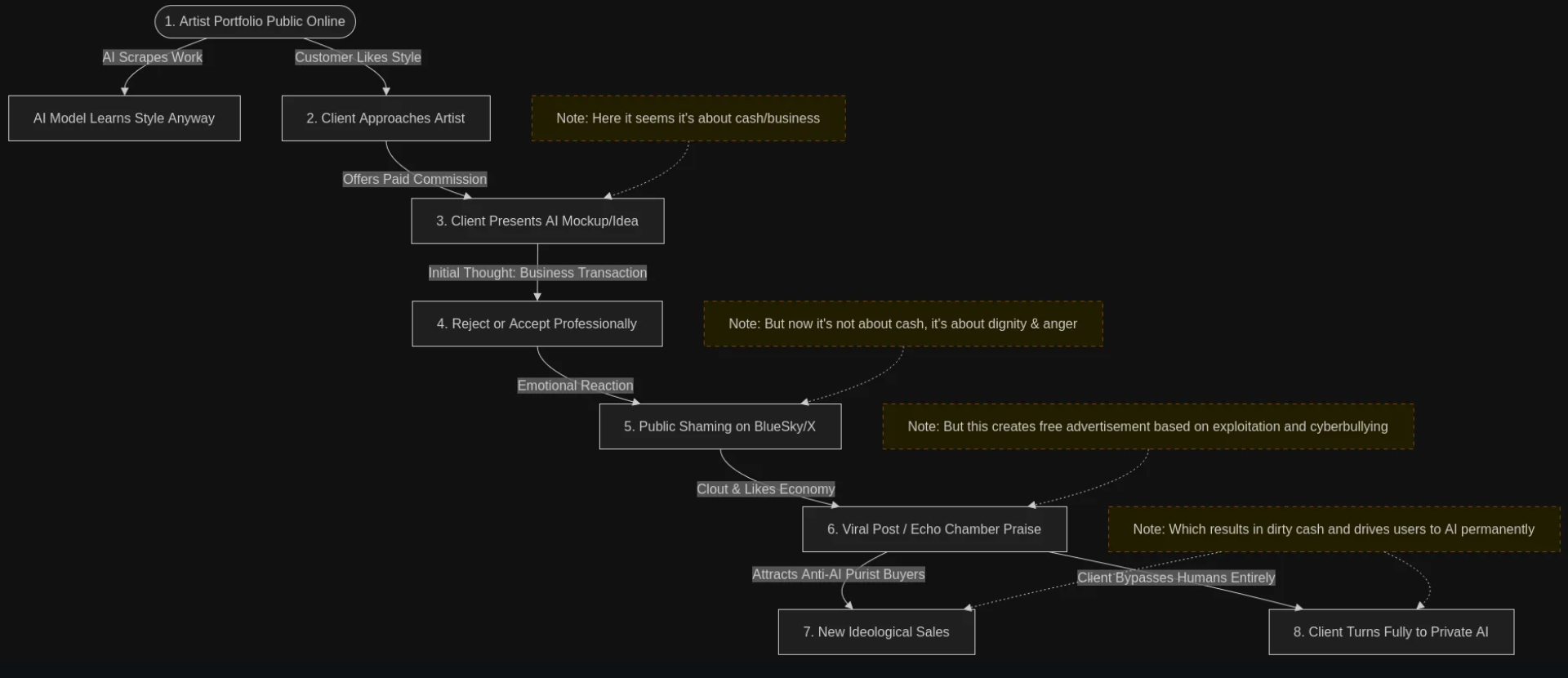
Note: open-in-new-tab on the diagram if your computer renders it weirdly
I used Gemini and Draw.io to complete this and did many drafts before posting. Gemini was a lifesaver to make it readable. This is an analysis on what happens when artists shame their customers for using AI as an idea-making tool.
It shook me a bit because it maps out exactly what is happening on platforms like BlueSky and X right now.
I used to think: “Surely artists just want to protect their businesses? They aren’t bad people, they are just afraid of AI training on their commissions.” But that fear doesn’t explain why some choose to publicly attack, dox, or hate on regular people in their inboxes.
If you look at the actual logic, the artist loses the data battle either way:
- Scenario A: The artist accepts a commission. A client uploads it online, and a web-crawler scrapes it. (Loss of data control).
- Scenario B: The artist rejects the client. They sell their work to a different client who uploads it online, and a web-crawler scrapes it anyway. (Loss of data control).
The AI scraping machine does not care. So why reject an immediate, real-money commission over a reference mockup? If it’s only about cash, hating on a customer makes no sense. (Rejecting a client is a perfectly fine boundary; publicly hating them is a completely different story).
When you look past the cash, the actual cycle looks like this:
- The Approach: A paying customer loves an artist’s style and offers real cash for a commission, using an AI image purely as a visual mockup to explain their vision. (Note: Here, it seems like a standard business transaction).
- The Turn: The artist rejects the project out of anger and fear of AI, prioritizing personal principles over immediate income. (Note: Now it’s not about cash—it’s about dignity and an emotional culture war. It would be completely fine to stop here, but some choose to continue).
- The Shaming: Instead of a private, professional rejection, the artist posts screenshots of the private DM interaction on BlueSky/X to get likes, retweets, and validation from their anti-AI followers. (Note: This creates highly effective, free advertisement based on targeted harassment and cyberbullying. Hence, dirty money through exploitation).
- The Result: The viral drama brings the artist fresh sales and commissions from anti-AI ideological purists who want to “support” them. Meanwhile, the humiliated customer leaves human creator spaces permanently to use private AI tools instead. (Note: This results in dirty cash for the artist via exploitation, but it actively drives users completely into the AI ecosystem).
- The Outcome: The client feels hurt, and others feel anger. This pushes people to actively train the artist’s works into a custom LoRA out of frustration. (Note: This is where the un-ethical training begins - and - its easy to stop here. But if we continue we see, it’s not “just” revenge, its for the first reason the client approached the artist in the first place:
they liked their artso in some messed up, twisted way? its a compliment to the artist.).
By turning a private business transaction into viral content, the artist is running an exploitation loop—damaging regular humans for their own personal gain. If an artist treats their marketplace like a battlefield, they shouldn’t be shocked when clients choose the “lesser evil” and just stick to the algorithm, where nobody publicly humiliates them for trying to pay for a service.
Personal Note:
I do not encourage anything malicious mentioned here. I do not encourage un-ethical training without consent, and I do not encourage bullying. What I am saying is that this toxic approach actively drives people to train LoRAs without consent. This cycle should not be a shock to the artists who engage in it.
Thanks for reading.